Express intent
A person, application or bounded agent states the task and expected outcome.
Private Unified Language Systems and AI Runtime
An open research initiative and reference architecture for organizations that want strong language models in their own environment—without surrendering data authority, operational control or the freedom to change models.
01 / System view
Every request passes through one visible operating model.
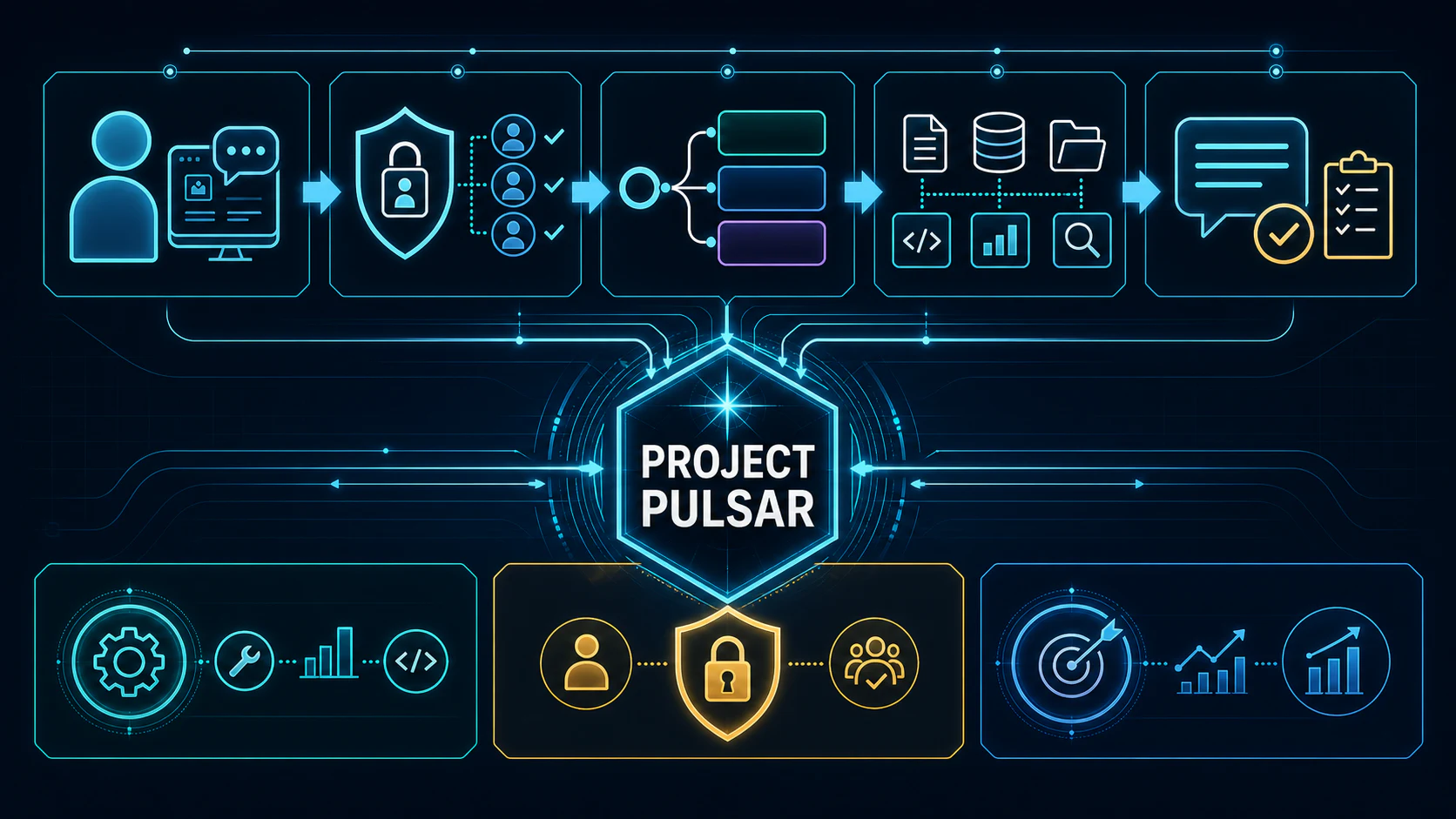
A person, application or bounded agent states the task and expected outcome.
Identity, purpose, data boundary and available actions are resolved.
The runtime selects context, tools and the smallest capable model path.
Permitted knowledge and tools are used inside observable boundaries.
Grounding, uncertainty and policy checks determine whether to answer or escalate.
02 / Capability map
Different tasks keep their own quality and risk policy while reusing common controls.
Find, compare and explain governed knowledge with source authority intact.
Turn signals and events into structured, testable investigation paths.
Connect evidence across records while keeping critical judgment human.
Assist code and analysis through bounded tools, tests and review.
Build source-linked briefs that expose options, gaps and uncertainty.
Coordinate approved steps without granting silent or unlimited action.
03 / Operating principles
Information remains within an approved trust boundary.
Capability follows the work—not a permanent model assignment.
Sources, checks and uncertainty travel with the outcome.
Human authority is explicit wherever consequence is high.
Public vision graphics
 Open full size ↗
One public-safe system view connects intent, authority, adaptive routing, permitted context, accountable outcomes, trust and evidence-led growth.
Manifesto & rationale
The thinking behind the system
Project PULSAR is being established as an independent research and development initiative focused on one practical question: how can organizations operate strong open-weight language models inside their own environments without compromising security, sustainability or human authority?
The initiative develops public reference architectures, evaluation methods, cost models and operating principles. It does not promote one model, hardware vendor or procurement path. It makes the assumptions visible so organizations can test them against their own workloads and constraints.
AI adoption often begins with isolated assistants, disconnected model endpoints and repeated integration work. That fragmentation makes it difficult to apply one security model, understand quality, control cost or change direction as models evolve.
Project PULSAR imagines a different foundation: a private, unified runtime that sits between applications and a changing landscape of models, knowledge sources and tools.
It is not a single chatbot and it is not a bet on one model family. It is the durable layer that decides how intelligence is accessed, grounded, governed and observed.
Local operation is the default research boundary. External services may still have a role, but sensitive context and consequential work should not leave an accountable environment merely because a model endpoint is convenient.
The ambition is simple: make advanced intelligence easier to use without making trust harder to maintain.
PULSAR creates a common path for knowledge assistance, operational insight, engineering analysis, software work, multimodal understanding and bounded agent workflows. Each use case can apply its own data, risk and quality policy while reusing the same core controls.
The result is not uniformity. It is coherence: one place to express trust, route work, measure outcomes and evolve the intelligence underneath.