Intent
Task and expected outcome
Conceptual architecture
PULSAR separates the durable control plane from replaceable models, tools and knowledge systems—creating one governed path from intent to outcome.
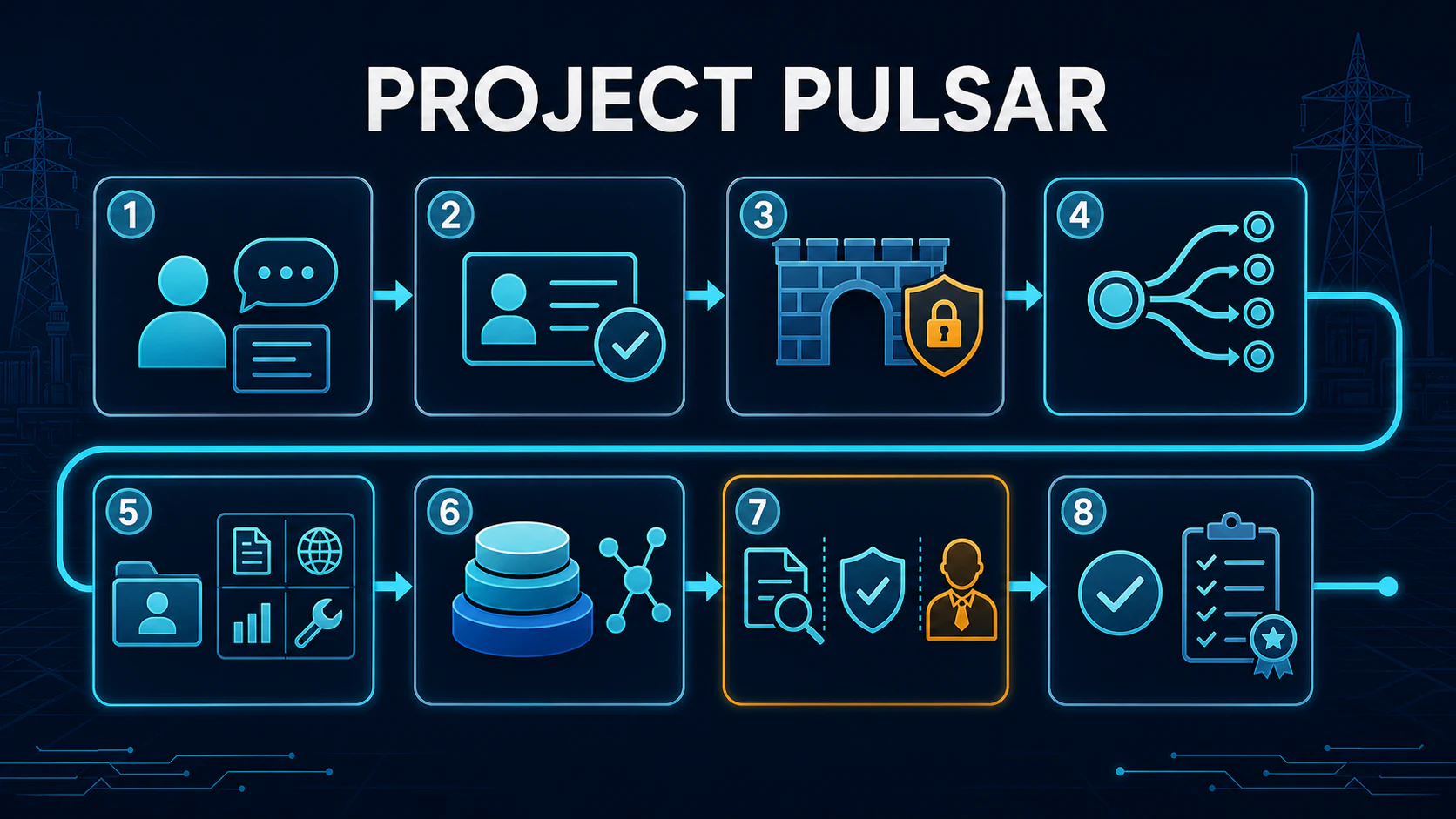
01 / Request lifecycle
Eight observable stages make routing, authority and evidence explicit.
Task and expected outcome
Who or what is asking
Purpose, scope and risk
Capability path selection
Permitted knowledge and tools
Fast, deep or escalated execution
Evidence, uncertainty and review
Response, action and trace
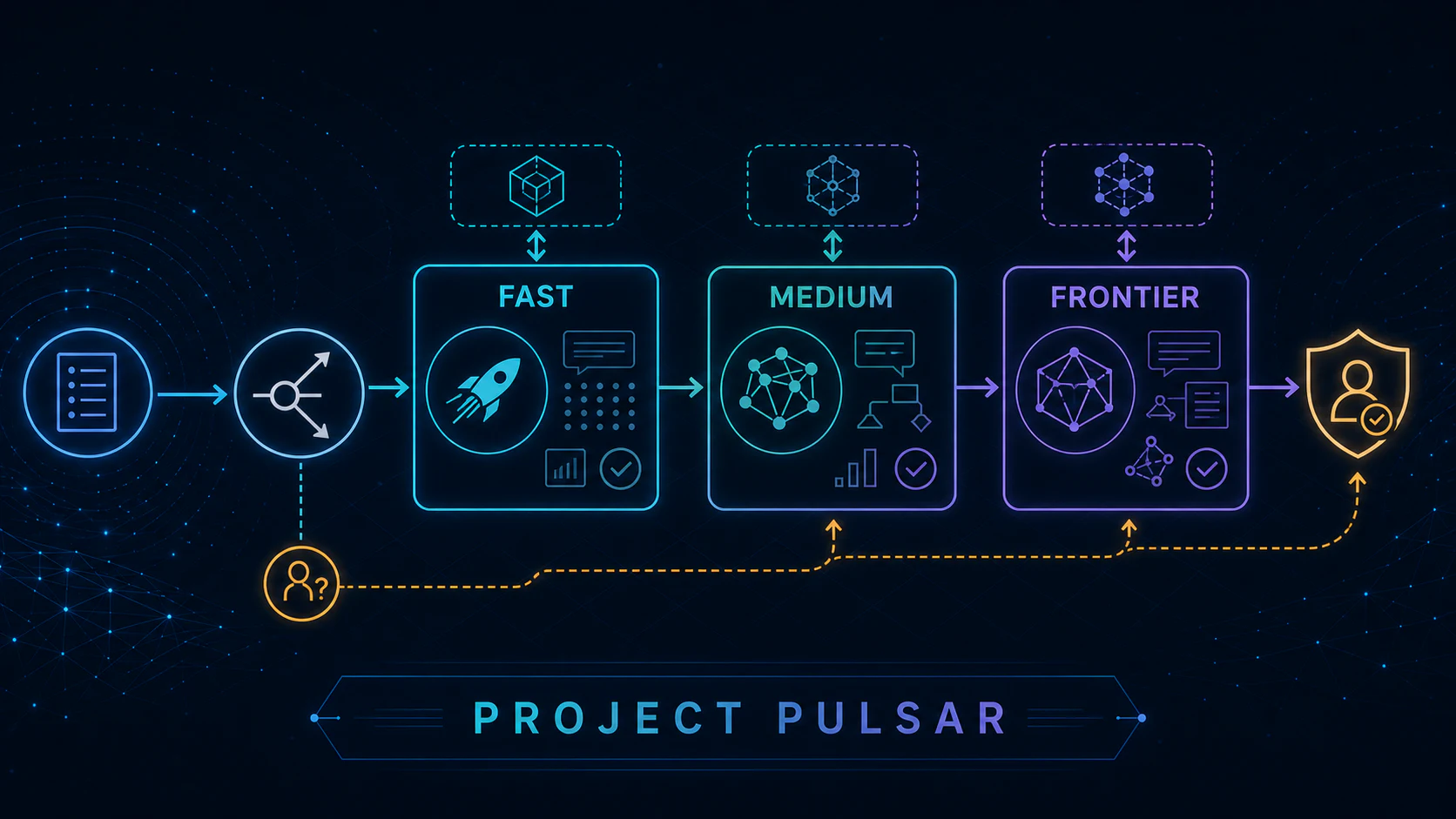
02 / Adaptive model paths
The tiers describe operating intent—not fixed model sizes or permanent assignments.
Routine classification, retrieval, extraction and short-form assistance.
Low frictionMulti-step synthesis, richer context and domain-oriented reasoning.
Measured depthNovel or demanding work that earns additional depth and review.
Explicit gatePublic vision graphics
 Open full size ↗
Eight visual stages move from intent and identity through policy, routing, context and execution to verification and an accountable outcome.
 Open full size ↗
Fast, Medium and Frontier represent replaceable operating paths. Low confidence can trigger escalation; consequential outcomes retain human review.
Manifesto & rationale
The thinking behind the system
The platform is designed as a set of open boundaries rather than one inseparable stack. Each layer has a specific responsibility and an observable contract with the next.
Requests begin with identity. The runtime evaluates who or what is asking, the purpose of the request, the permitted data boundary, the available tools and the risk class of the task.
A consistent application interface applies quotas, request validation and trace context. A router then chooses an appropriate capability path according to task type, quality, latency, cost and risk signals.
Retrieval introduces only information the requesting identity is allowed to use. Tool calls operate through explicit allowlists, bounded execution and approval points. Context carries source and permission metadata forward.
Fast, medium and frontier capability tiers provide different balances of responsiveness and depth. The tiers are planning concepts—not fixed parameter counts or permanent model assignments.
Outputs can be checked for grounding, policy compliance and uncertainty. The runtime records enough context to explain which route was taken, what evidence was used and where human review remains required.
Models, retrieval engines, serving runtimes and storage technologies will continue to change. PULSAR treats that change as expected. Open interfaces, versioned contracts and evaluation gates allow components to evolve without dissolving the trust boundary around them.
The control plane manages policy, identity, routing, model lifecycle, evaluation and service health. The data plane executes requests, retrieves permitted context, invokes approved tools and serves model output.
Separating these concerns makes ownership clearer and helps high-impact changes pass through explicit validation before they affect live workloads.